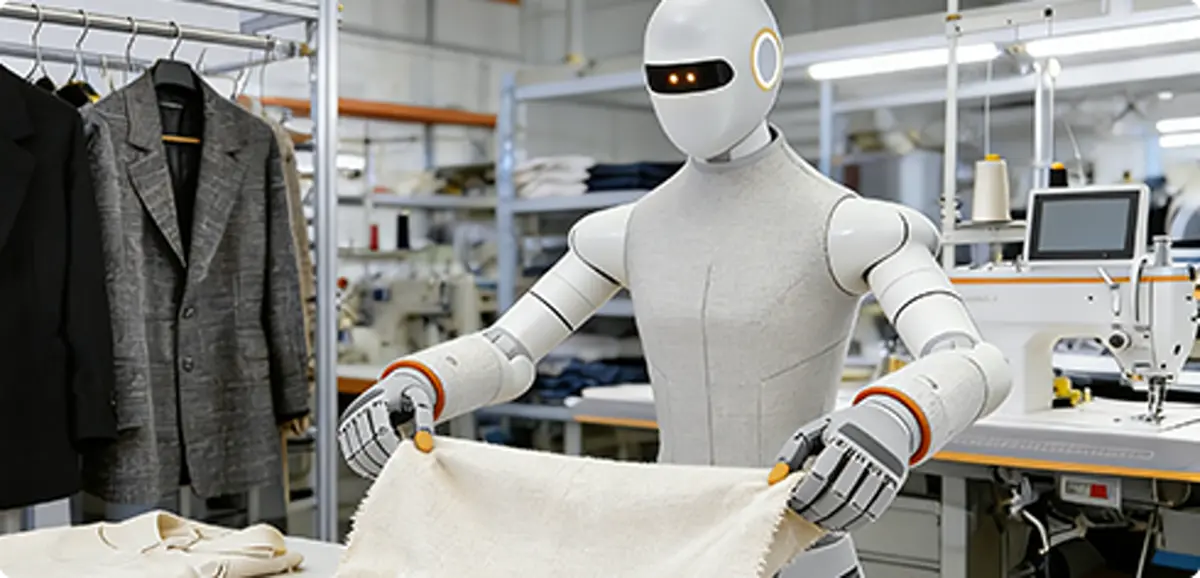
Peacebird successfully validated its Aitu sewing robots on complex factory cuff-handling tasks, marking a significant leap toward automated garment production lines.
The successful trial at Peacbird's factory in Ningbo demonstrates the Aitu platform's capability to handle intricate, high-precision manipulation required in modern apparel manufacturing, moving beyond basic stitching functions. This validation signals a critical milestone in the industrial adoption of advanced robotics within the fast-fashion and high-volume textile sectors.
The implementation addresses long-standing bottlenecks in garment assembly, specifically the dexterity required to manage irregularly shaped fabric components like cuffs. By proving proficiency in this demanding task, Peacebird positions the Aitu system as a viable, scalable solution for manufacturers aiming to increase throughput while mitigating labor dependency.
Technical Capabilities and Operational Dynamics
The Aitu robots utilize sophisticated sensor arrays and proprietary control algorithms to achieve the necessary precision during cuff attachment. These systems are engineered not merely for repetitive action, but for adaptive handling, allowing the robots to compensate for minor variations in fabric tension and material thickness encountered on a live production floor.
From a hardware perspective, the integration involves specialized end-effectors designed for grasping and maneuvering textile materials with minimal damage. The software stack managing the process incorporates real-time vision processing, enabling the robot to identify precise stitching points and maintain consistent seam placement across thousands of cycles. This level of integration minimizes human intervention during the most delicate stages of garment construction.
Commercially, the validation suggests a shift away from fully manual or semi-automated processes toward genuinely autonomous assembly lines. Peacebird's deployment showcases a system designed for integration into existing, complex factory workflows, rather than demanding complete overhauls of legacy infrastructure, thereby lowering the barrier to entry for adoption.
Industry Trajectory and Market Implications
The successful deployment of the Aitu platform underscores the accelerating trend toward hyper-automation in global supply chains. As labor costs rise and demand for speed intensifies, the integration of highly dexterous robotics becomes a strategic imperative for manufacturers seeking competitive advantage.
Geopolitically, this development impacts the manufacturing landscape by offering alternatives to traditional labor-intensive production models. If these advanced robotic systems can reliably handle complex tasks like cuff handling, it alters the calculus for sourcing production, potentially shifting some manufacturing sophistication closer to high-wage economies or enabling smaller, high-tech local production hubs.
The long-term implication is the refinement of the "lights-out" factory concept. By mastering nuanced tasks such as cuff manipulation, Peacebird is demonstrating that the next generation of industrial robots moves beyond simple pick-and-place operations into genuine, high-skill assembly, fundamentally redefining the operational ceiling for textile manufacturing operations worldwide.