🎙 Listen to a summary of this story
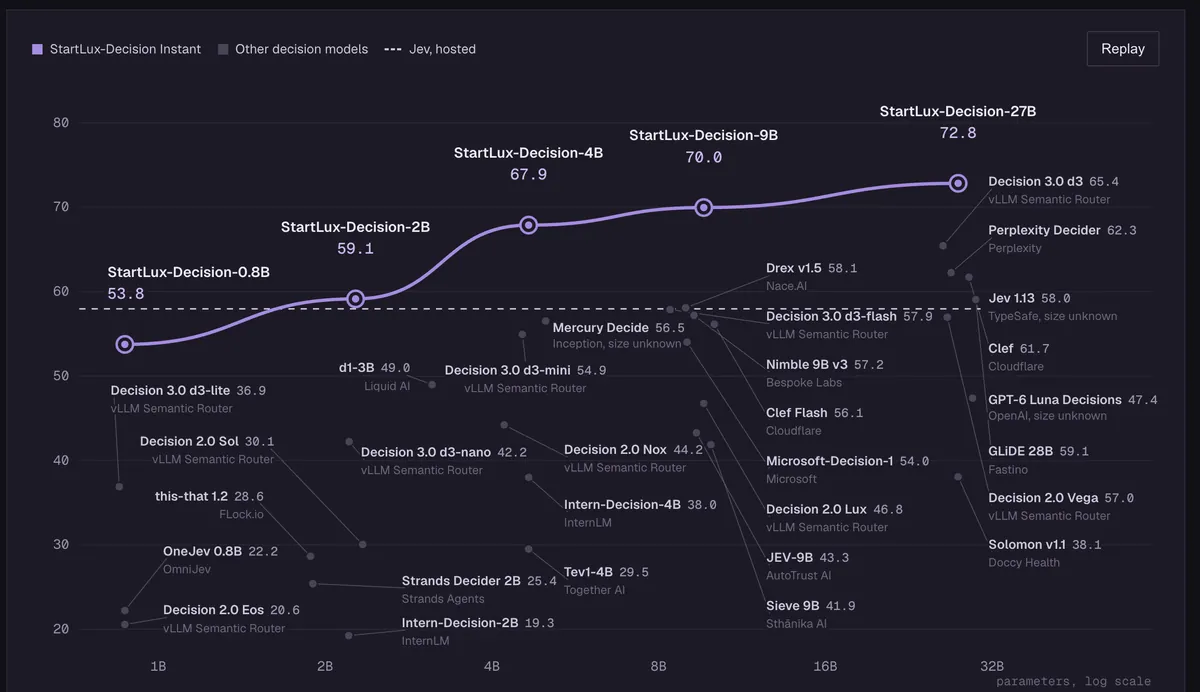
StartLux-Decision v1.1 has surpassed the Decision Index 0.3.2, demonstrating a novel capability where open models actively engage in 'auto-think' processes exclusively when encountering epistemic uncertainty.
This advancement represents a significant shift in how autonomous systems manage knowledge gaps within complex decision pathways. Instead of defaulting to probabilistic guesswork or relying solely on pre-trained weights when faced with ambiguous input, the v1.1 architecture initiates an internal reasoning loop—a form of meta-cognition—to resolve uncertainty before committing to an output.
The implications for high-stakes applications, such as algorithmic trading, medical diagnostics, and autonomous vehicle navigation, are profound. By quantifying and actively addressing its own lack of certainty, the system moves beyond simple predictive modeling toward genuine, if constrained, reasoning capability within open-source frameworks.
Technical Architecture and Operational Dynamics
The core innovation resides in how StartLux-Decision v1.1 interfaces with its underlying open models. The framework incorporates a specialized uncertainty quantification module that monitors the entropy across feature vectors during inference. When this entropy crosses a dynamically set threshold, the system triggers the 'auto-think' sequence.
This auto-thinking mechanism is not merely a confidence score adjustment; it involves prompting the model to internally generate hypothetical scenarios or query latent knowledge representations specific to the uncertain data point. The process utilizes an iterative refinement loop, allowing the model to self-correct its initial hypothesis based on simulated internal deliberation before presenting the final decision.
Furthermore, the integration maintains compatibility with existing open model ecosystems, ensuring that this capability is accessible without necessitating a complete overhaul of established deployment pipelines. This modularity positions v1.1 as an infrastructural upgrade rather than a proprietary black-box replacement for many current deployments.
Industry Trajectories and Geopolitical Ramifications
The successful implementation of uncertainty-aware reasoning in open models accelerates the trend toward more transparent and auditable AI systems. For industries facing stringent regulatory oversight, such as finance or healthcare, the ability to trace a decision back to an explicit moment of acknowledged doubt—and the subsequent corrective thought process—is invaluable for compliance.
From a geopolitical standpoint, this capability reinforces the strategic importance of open-source advancements in AI. If proprietary systems maintain opaque certainty even when fundamentally uncertain, models like StartLux-Decision offer a viable path toward democratizing advanced cognitive functions across research institutions globally.
The market response suggests that enterprises are moving past simple performance benchmarks (like raw accuracy) and prioritizing robustness against ambiguity. Systems that can intelligently admit what they do not know, and then actively work to understand it, represent the next critical inflection point in enterprise AI adoption, potentially disrupting current vendor lock-in strategies.