
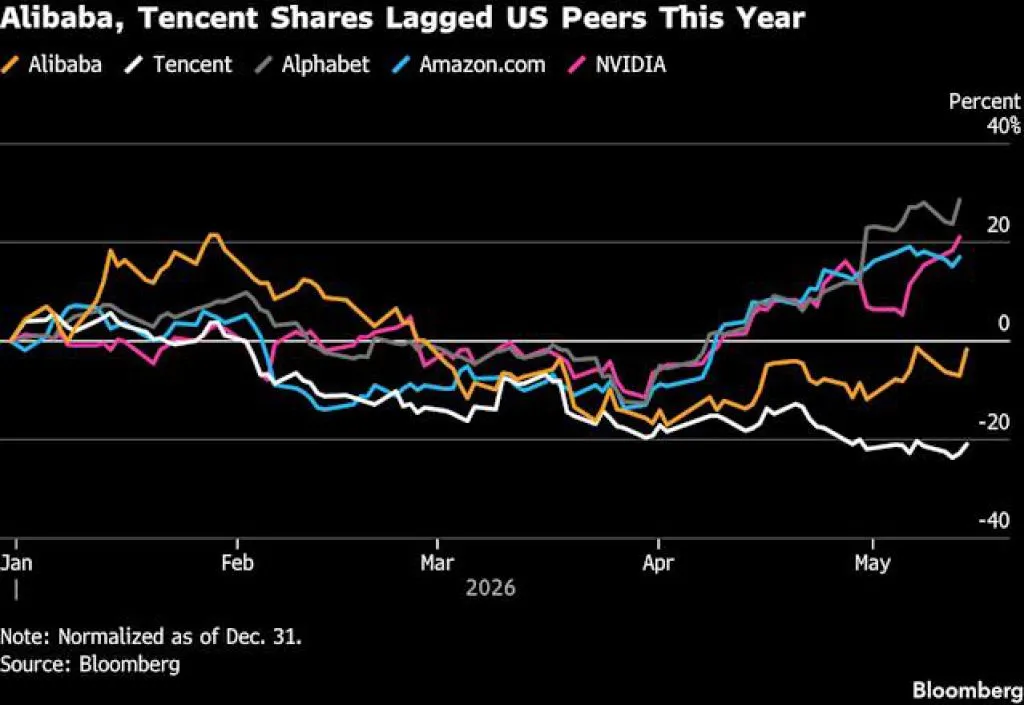
Tencent and Alibaba sales disappointed despite massive AI spending, signaling a current failure in monetizing substantial investments into artificial intelligence.
The tech giants are facing mounting pressure as their aggressive financial outlays toward AI initiatives have not yet translated into commensurate revenue growth. This divergence between capital expenditure and top-line performance presents a critical inflection point for the Chinese technology sector, demanding immediate strategic recalibration from both firms.
According to recent analyses, the sheer scale of investment—with reports citing over $56 billion poured into AI technologies by these players—has not yielded the expected return. The market sentiment reflects concern that while the race for AI dominance is fierce, the pathway to sustainable profitability remains tenuous in the current operational environment.
Tencent, a major force in social media and gaming, has seen its sales figures underperform expectations relative to the pace of its technological adoption. Similarly, Alibaba, a titan of e-commerce and cloud services, is grappling with headwinds that suggest its AI deployments are currently serving more as strategic positioning plays than immediate profit drivers.
The narrative shift in the industry suggests investors are moving from celebrating spending prowess to scrutinizing execution efficiency. The expectation was that massive foundational model development and integration into core platforms would unlock new, high-margin revenue streams, particularly within enterprise solutions and advanced consumer services.
AI Investment vs. Market Reality
The financial data underscores a disconnect between technological ambition and immediate commercial success. Companies are deploying vast resources to secure algorithmic supremacy, yet the current sales environment suggests that customer adoption or effective upselling of these AI capabilities is lagging behind the expenditure rate. This creates an elevated risk profile for both firms.
Alibaba's investments in cloud computing infrastructure, heavily augmented by proprietary AI engines, are expected to eventually capture significant market share from international competitors. However, the immediate quarterly results indicate that the migration of legacy clients and the adoption of premium, AI-enhanced services have been slower than forecasted models predicted. The pressure is not merely on revenue volume but on the margin quality derived from these new technological layers.
For Tencent, the challenge lies in integrating sophisticated generative AI across its sprawling ecosystem—from WeChat to cloud services. While the platform offers unparalleled user data density for training superior models, translating that data advantage into a demonstrable, paid-for feature remains complex. The market is demanding evidence of monetization pathways beyond simple ad impressions.
Analysts suggest that the current environment requires companies to move past 'AI infrastructure spending' toward 'AI application revenue.' Simply building powerful models does not constitute a viable business strategy without a clear mechanism for charging value against them. This strategic gap is where the disappointing sales figures are rooted.
Strategic Implications for Chinese Tech
The performance of Tencent and Alibaba sets a critical benchmark for the broader Chinese technology landscape. If these two market leaders cannot successfully bridge the gap between billion-dollar AI investments and robust sales growth, it raises serious questions about the current state of digital transformation monetization within China.
Regulators and investors alike are watching closely to see if these firms can pivot their spending from pure R&D expenditure toward scalable, revenue-generating deployment. The sustained commitment to AI is not in question; rather, the viability of the *current* business model built around this investment is under intense review.
The pressure exerted by disappointing sales forces a necessary consolidation of focus: prioritizing high-yield applications over broad technological coverage. Success will hinge on proving that their proprietary AI tools solve acute, expensive problems for businesses willing to pay premium rates, rather than merely offering incremental improvements to existing services.
Ultimately, the next reporting cycles will be scrutinized not just for sales figures, but for qualitative evidence detailing how each company is actively and successfully converting algorithmic capability into tangible financial returns.