Unitree achieved a 70% surge in quarterly revenue, underscoring massive market traction despite significant capital expenditure on artificial intelligence development.
The robotics firm reported robust financial performance for the recent period, demonstrating strong uptake in its autonomous hardware across commercial and industrial sectors. This accelerated top-line growth confirms the increasing global appetite for sophisticated, mobile robotic solutions capable of navigating complex real-world environments.
However, the financial report simultaneously revealed a clear strategic trade-off: aggressive reinvestment into advanced AI capabilities is exerting considerable pressure on the company's net profitability. This dynamic illustrates the current industry tension between rapid market capture and immediate bottom-line optimization in the high-tech hardware space.
Commercial Dynamics and Technological Scaling
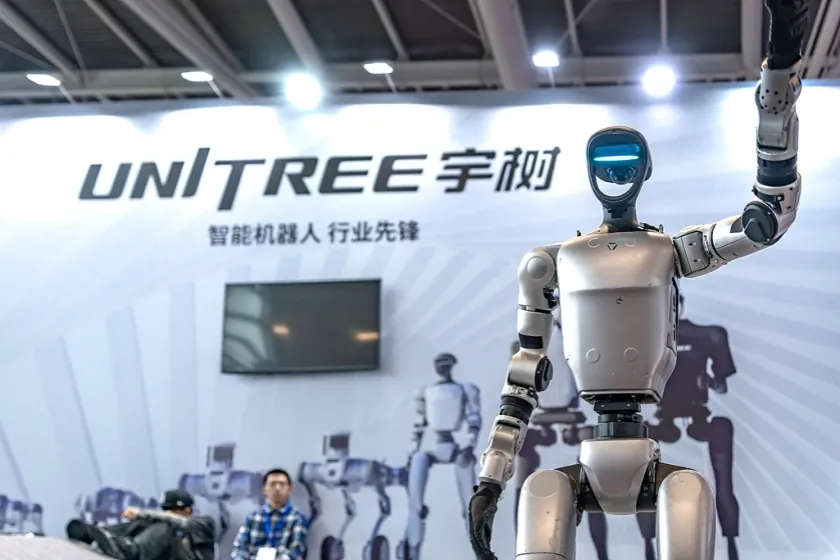
The revenue expansion is directly tied to the deployment of Unitree’s advanced quadruped robots, which are increasingly being integrated into logistics, surveillance, and inspection workflows. The company’s ability to scale production while maintaining the high degree of autonomy in its hardware represents a critical commercial achievement. These machines are moving beyond laboratory demonstrations into tangible, operational use cases.
The core of the financial strain appears to stem from the accelerated R&D cycle dedicated to enhancing the robots' machine learning capabilities. Unitree is reportedly pouring resources into refining perception systems and improving real-time decision-making algorithms, moving toward fully generalized AI platforms. This deep technological pursuit, while costly in the short term, positions the company for higher margin capture in future product iterations.
Analysis of the earnings call indicates that the company views the current profit compression not as a failure, but as a necessary investment phase. The goal is to cement a technological moat around its product line, ensuring that future revenue streams are underpinned by proprietary, difficult-to-replicate AI advantages.
Industry Trajectory and Geopolitical Positioning
Unitree's performance serves as a microcosm for the broader global robotics race, where hardware capability is rapidly merging with software intelligence. The market is shifting from simply purchasing mobile platforms to acquiring intelligent agents capable of complex task execution without constant human intervention.
Geopolitically, the success of Chinese robotics firms like Unitree places them in a strong competitive posture against established Western incumbents. Their rapid iteration cycles and substantial funding allow them to deploy cutting-edge AI into commercially viable products faster than many legacy players can adapt.
The sustained investment trajectory suggests a commitment to challenging the perception of robotics as a niche automation tool. Instead, Unitree is positioning its technology to become an essential, intelligent infrastructure component across various industries, thereby altering the competitive landscape for global automation providers. For investors, this mandates a focus on long-term technological dominance rather than immediate quarterly net income figures.