🎙 Listen to a summary of this story
Chinese robots are finding work beyond factory floors, carrying restaurant dishes, delivering orders and cleaning hotel spaces. But the clearest evidence of their usefulness comes from narrowly defined jobs, with people still handling parts of the work.
Company disclosures and accounts of deployments show machines taking on specific service tasks in China and overseas. They offer a more grounded picture of the industry than demonstrations suggesting that humanoid robots will soon perform almost any job.
The distinction matters for businesses considering automation. Completed deliveries and named installations demonstrate practical applications. They do not necessarily establish profitability, reliability across different environments or the disappearance of human labour.
Delivery networks combine robots and people
Meituan provides one example of robots operating within an established service network. In its 2025 annual report, filed on April 24, 2026, the company said its drone delivery services had operated 70 routes in cities including Shenzhen and Shanghai, completing more than 780,000 orders by the end of 2025.
Those figures describe historical operations rather than the service’s current reach. They nevertheless identify an application with reported transactions, rather than a machine performing a selected task for an audience.
The report also describes ground delivery vehicles working alongside couriers. Under that arrangement, vehicles handle transportation while people complete the final 100 metres to customers.
That division illustrates how automation can change a job without taking over every stage. The delivery still depends on a wider system connecting merchants, machines, workers and customers.
Meituan says its drone navigation combines cameras, satellite positioning and other sensors. Such systems help machines locate themselves and navigate their surroundings, but their use should not be confused with evidence that a conversational AI model controls every action.
The disclosures do not independently establish profitability or how frequently people intervene.
Restaurants and hotels put machines into supporting roles
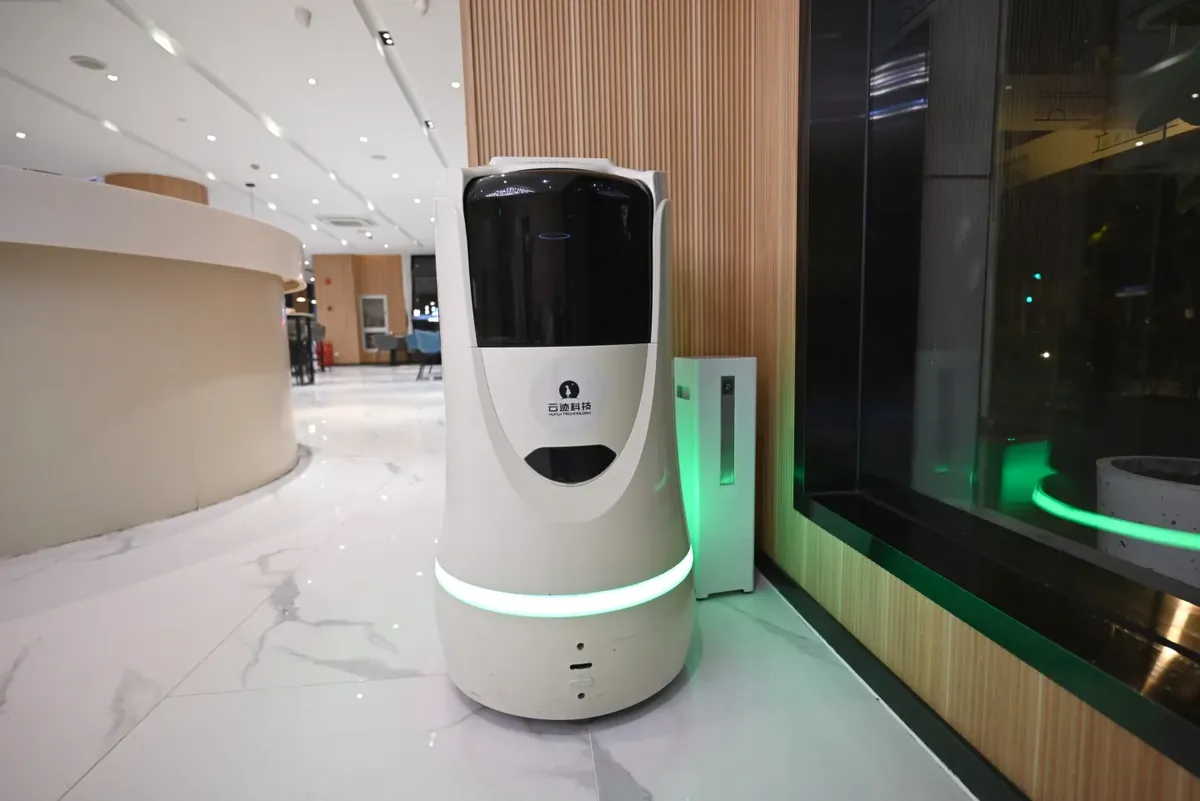
Inside restaurants, the work is more contained. Pudu Robotics’ Haidilao case study describes delivery robots transporting food at the Chinese restaurant operator.
The supplier’s account identifies a commercial application, although the page carries no visible publication date. It also promotes efficiency and cost savings, claims that cannot be treated as independently verified results without further information about operating conditions and measurement methods.
An overseas example offers a clearer view of how people and machines share responsibilities. In a December 22, 2023, statement, Shenzhen-based Pudu described robots assigned to food transport, dish return, cleaning and room deliveries at Parkhotel in Eisenstadt, Austria.
Austrian broadcaster ORF had reported on the hotel’s robots on July 15, 2023. Its account described staff loading food onto machines and removing dishes when they reached the appropriate tables.
The machines supported employees rather than completing restaurant service independently. The example also shows that Chinese robotics applications extend beyond China’s domestic market.
Both records are historical. They do not establish how many machines remain in operation at the hotel today, what maintenance has cost or whether anticipated benefits have endured.
Humanoid demonstrations face a different test
Humanoid robots require a separate assessment. Unitree’s official G1 product page, checked on October 19, promotes learning and manipulation capabilities while warning that some example functions remain under development and testing.
The warning highlights a distinction between showing a capability and delivering a dependable service. A demonstration establishes what a machine can do under selected conditions. A pilot tests it in a limited working environment. Deployment puts it into operational use, potentially with substantial supervision.
Our coverage of embodied intelligence examines the broader ambition to connect AI with machines that sense and act. For buyers, however, the immediate question is whether a particular system can complete a particular job consistently.
A useful trial would record successful tasks, failures, human interventions, downtime and installation and support costs. It would also establish who can stop the machine and take over unfinished work.
Similar questions arise in the WeKnora guide to document search and agent workflows: finding information and authorising action require different safeguards.
For businesses weighing robotics, the evidence to request is an operating record from a comparable workplace. That provides a firmer basis for a purchasing decision than a polished demonstration alone.
```