🎙 Listen to a summary of this story
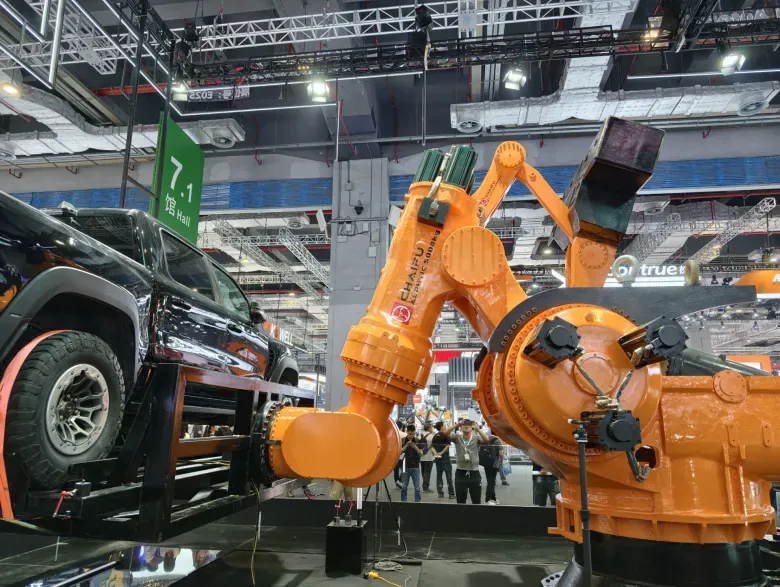
China unveiled a significant five-ton-payload robotic system at the China International Import Expo (CIIF) in Shanghai, marking a tangible step forward in heavy-duty automation capabilities. While the debut of the the CR5000-3700 heavy-duty industrial robot from Shanghai Chaifu Robotics showcases advanced domestic engineering prowess, industry observers stress that operational efficacy in diverse, real-world environments will ultimately determine its true market penetration and strategic value.
This unveiling represents a concentrated effort by Chinese manufacturing sectors to bridge the gap between sophisticated prototype demonstration and robust industrial deployment against established global competitors. The machine's arrival at CIIF signals Beijing’s continued emphasis on achieving technological self-sufficiency in core heavy industry applications, particularly those requiring substantial lifting power and precision navigation.
The immediate significance lies not just in the payload capacity—five tons is a notable benchmark for mobile industrial robotics—but in the implied maturation of the underlying control systems required to safely and efficiently manage that mass across complex factory floors or construction sites. The focus now shifts from 'can it be built' to 'how reliably can it perform.'
Technical Specifications and Operational Nuances
The robotic platform reportedly integrates advanced sensor fusion technology, allowing for enhanced situational awareness crucial for navigating dynamic operational zones. Technical specifics detailed at the expo suggest a hydraulic or electric drive system optimized for high torque delivery while maintaining acceptable energy efficiency over prolonged cycles.
Beyond raw lifting power, the sophistication of the accompanying software suite is a critical differentiator. This includes AI-driven path planning and object recognition modules designed to handle unstructured environments, moving beyond the controlled parameters often found in laboratory settings. The integration level between hardware actuation and algorithmic decision-making defines its practical utility.
Commercial dynamics surrounding such large-scale machinery are complex; adoption hinges on total cost of ownership (TCO), maintenance accessibility within existing industrial infrastructures, and compatibility with legacy operational technology (OT). Early assessments suggest Chinese manufacturers are aggressively targeting mid-to-large enterprises seeking to upgrade aging manual or semi-automated lifting equipment.
Geopolitical and Market Implications
This deployment fits squarely into China's broader strategic push toward industrial modernization and the 'Made in China 2025' objectives. Successful scaling of such heavy robotics directly supports national goals for high-end manufacturing output and reduced reliance on imported capital equipment.
Geopolitically, it places Chinese automation hardware more firmly into direct competition with established European and Japanese industrial giants. While initial market acceptance may be slow due to ingrained vendor loyalty, the demonstrated capability lowers the technical barrier for entry in demanding sectors like automotive assembly and materials handling.
The long-term implication is a potential reshaping of global heavy automation supply chains. If these systems prove durable under rigorous testing—and assuming successful post-debut iteration cycles—they could catalyze a significant shift toward regionalized, domestically supplied industrial solutions across Asia and beyond. Further validation through third-party deployment trials remains the definitive metric for this technological assertion.