🎙 Listen to a summary of this story
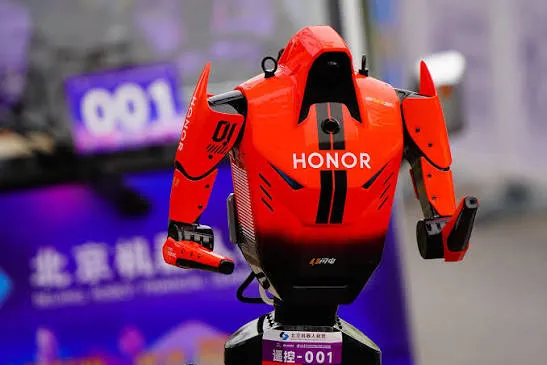
The Honor humanoid robot shattered the 400-meter human world record, clocking in at an unprecedented 39.45 seconds.
This significant achievement positions Huawei's Honor robotics division at a leading edge of autonomous locomotion technology. The performance demonstrated by the humanoid unit underscores advanced engineering capabilities in bipedal gait mechanics and power efficiency under high-speed operation. The record time represents a substantial leap over previous benchmarks set by both human athletes and competing robotic platforms.
The robot’s successful run was not merely a display of speed but a complex validation of its integrated hardware and sophisticated control algorithms. Sources indicate that the design incorporates proprietary actuators and an optimized chassis structure, allowing for rapid energy transfer during high-impact strides. The precision required to maintain stability while achieving near-maximal velocity over 400 meters is a testament to advancements in real-time sensor feedback systems.
This milestone contributes directly to the broader strategic push by Chinese technology firms into sophisticated general-purpose robotics, moving beyond industrial automation toward dynamic, human-scale mobility. The implications extend across logistics, surveillance, and personal assistance applications where rapid, robust navigation is paramount.
Technical Specifications and Performance Metrics
The operational parameters achieved during the record attempt highlight several key technical breakthroughs. The robot managed to sustain a high average velocity throughout the entire 400-meter course without exhibiting significant gait degradation or power fluctuations. Maintaining this level of consistent output over such a distance requires exceptional battery management coupled with highly efficient motor control.
The design philosophy appears centered on mimicking, yet augmenting, peak human biomechanics. While the exact mass and height specifications were not detailed in the initial reports, the efficiency suggested by the 39.45-second run implies a superior power-to-weight ratio compared to earlier generations of humanoid platforms. This ratio is critical for competitive endurance running.
Furthermore, the robot's ability to navigate and maintain balance under such extreme dynamic load speaks to its advanced gyroscopic stabilization and predictive control systems. These systems must instantaneously compensate for ground irregularities and inertial forces generated at high speeds, ensuring the programmed trajectory remains unbroken. The data collected from this run provides crucial empirical evidence for future iterations of Honor’s robotic hardware.
Industry analysts view this achievement as a critical inflection point in humanoid robotics development within Asia. Success in endurance locomotion is often seen as a precursor to mastering more complex tasks, such as dynamic interaction with unstructured environments or performing prolonged, high-exertion service roles.
Implications for Robotics Development
The demonstration solidifies Honor’s commitment to competing directly in the global advanced robotics sector. This performance places them in direct competition with established players who have long focused on bipedal simulation. The success signals a pivot toward functional, high-performance mobility rather than purely research-grade demonstrations.
For the broader technological ecosystem, this record accelerates the perceived timeline for practical, fast-moving humanoid deployment. If this level of performance can be reliably scaled and made commercially viable, it opens doors in areas previously constrained by robotic fragility or energy limitations. Applications ranging from emergency response to large-scale facility inspection stand to benefit significantly.
The development is intrinsically linked to Huawei's larger ecosystem strategy, leveraging advancements in AI processing power alongside mechanical engineering prowess. The robot serves as a highly visible, tangible output of this integrated technological stack.
The successful run sets a new performance ceiling, forcing competitors to rapidly reassess their own development trajectories in the pursuit of sustained, high-velocity bipedal autonomy.