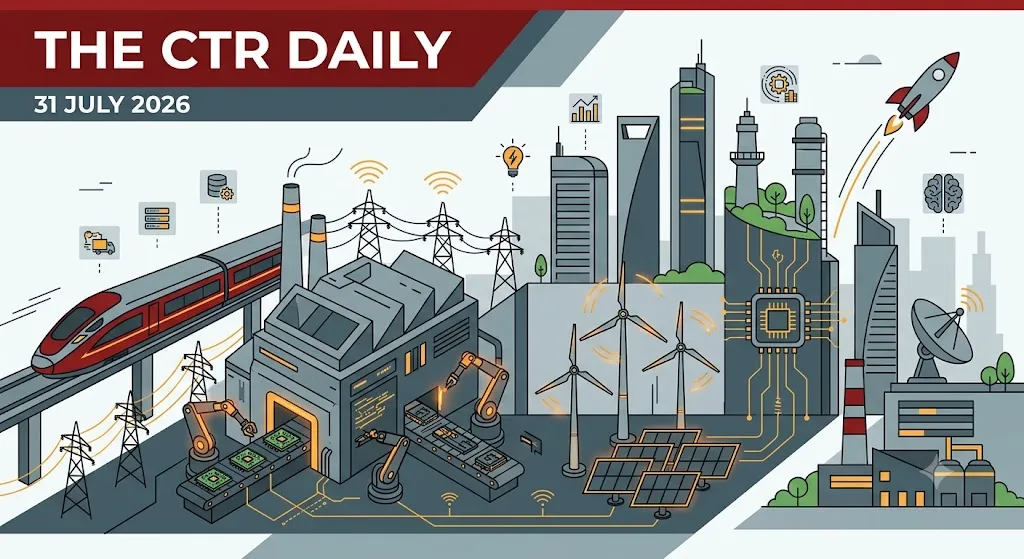
Today's CTR: The Chinese technology landscape continues its disciplined pivot toward self-sufficiency and systemic depth. Whether it is Huawei engineering a pathway beyond traditional chip scaling, or ByteDance embedding advanced intelligence locally on edge devices, the narrative has shifted from mere feature addition to foundational architectural control. This focus on proprietary systems—from silicon design to robot management platforms—signals an ecosystem maturing past rapid prototyping toward building durable, domestically controlled industrial infrastructure.
Huawei Mate 90 Series Set to Debut with New Kirin Chipset, Signaling Tech Recovery
Anticipation is building for Huawei's upcoming Mate 90 series, which is expected to debut this autumn powered by a proprietary new Kirin chipset. This move represents a calculated effort to solidify the company’s premium mobile segment presence while navigating ongoing geopolitical component restrictions.
The integration of in-house silicon is viewed by analysts not merely as a hardware upgrade but as a strategic pivot toward technological autonomy, directly challenging rivals in the global smartphone arena. Success here provides tangible proof of concept for Huawei's domestic R&D capabilities.
This launch serves as a barometer for how effectively Chinese giants are replacing external dependencies with internal engineering prowess.
ByteDance Unveils Lance: A Native Multimodal LLM Designed for Local, Edge AI
ByteDance has introduced Lance, a native multimodal large language model capable of executing entirely on 40GB of Video RAM (VRAM). This places the model firmly in the realm of edge and localized artificial intelligence deployment.
By running complex reasoning locally, Lance directly mitigates concerns over data privacy, latency, and operational costs associated with continuous reliance on external cloud infrastructure. The unified architecture allows for coherent interpretation across text and images within a constrained hardware environment.
This development signals a necessary shift in enterprise AI adoption, prioritizing data sovereignty alongside state-of-the-art functionality.
Huawei's Tau Law: Logic Folding as the Next Frontier to Sub-2nm Chip Manufacture
Huawei has put forward the "Tau Law," proposing logic folding as the essential architectural pathway beyond traditional Dennard scaling limits. This framework suggests that future performance gains will derive more from organizational efficiency than purely geometric shrinkage.
Logic folding involves restructuring transistor connections to pack greater computational density into a fixed area, aiming for targets like 1.4nm while managing power consumption challenges. This fundamentally redefines the semiconductor challenge as one of topology rather than simply lithography.
If adopted widely, this roadmap could dictate advanced silicon development well into the latter half of the decade, offering an alternative escape route from conventional scaling constraints.
China Unveils First Humanoid Robot Lifecycle Management Platform to Scale Domestic Robotics
Beijing has debuted the nation's first humanoid robot lifecycle management platform, creating a necessary infrastructure layer for scaling complex domestic robotics fleets. This system provides end-to-end oversight from design through decommissioning.
By centralizing tracking of operational uptime and maintenance diagnostics, the platform facilitates predictive maintenance and standardizes protocols across heterogeneous robot models. It moves robotics beyond mere application into a fully managed, industrialized asset class.
This infrastructure is vital for de-risking investment and enabling wider enterprise adoption as China pushes advanced manufacturing dominance.
DeepSeek V4 Achieves Full Adaptation to Huawei Ascend AI Processor
The advanced Large Language Model (LLM), DeepSeek V4, has successfully adapted for native and efficient operation on Huawei’s Ascend Artificial Intelligence (AI) processor. This achievement validates the model's robustness within a localized, high-performance computing environment.
This deep integration is a significant step toward technological self-sufficiency in China's AI sector, insulating enterprises from potential vulnerabilities tied to foreign supply chains. The optimization process involved rigorous kernel and layer mapping specific to Ascend’s proprietary Instruction Set Architecture (ISA).
The successful porting solidifies the viability of building high-performance production systems entirely within the domestic technological sphere.
Trina Solar's THBC Technology: A BC Battery Architecture Redefiniing Energy Storage
Trina Solar has introduced its novel Trina High-efficiency Battery Cell (THBC) system, a new battery architecture designed to tackle degradation and power density limitations in solar energy storage. This represents a foundational shift away from conventional lithium-ion paradigms.
The THBC design focuses on stabilizing internal material interactions under repeated cycles, which translates directly into extended operational lifespans for utility-scale projects. Furthermore, its enhanced thermal management improves throughput across diverse global climates.
By offering a pathway to lower Levelized Cost of Storage (LCOS), this technology addresses core concerns for large-scale infrastructure investors in the renewable transition.
Honor Unveils Pioneering Robot Smartphone, Blending Mobile Tech with Robotic Design
Honor has revealed a pioneering robot smartphone, marking a pivot in consumer electronics toward integrating mechanical dynamism into the mobile form factor. The initial visuals suggest meticulous attention to high-grade alloys and complex internal engineering.
This device is less about computational power alone and more about redefining user interaction through physical responsiveness, blurring the line between passive computation and active mechanics. It functions as a bold technological statement regarding Honor's move up the value chain into electromechancal systems innovation.
The market will ultimately judge this endeavor on its ability to translate mechanical ambition into genuinely useful, scalable user benefits.